Liaison Couple for the Americas Zone
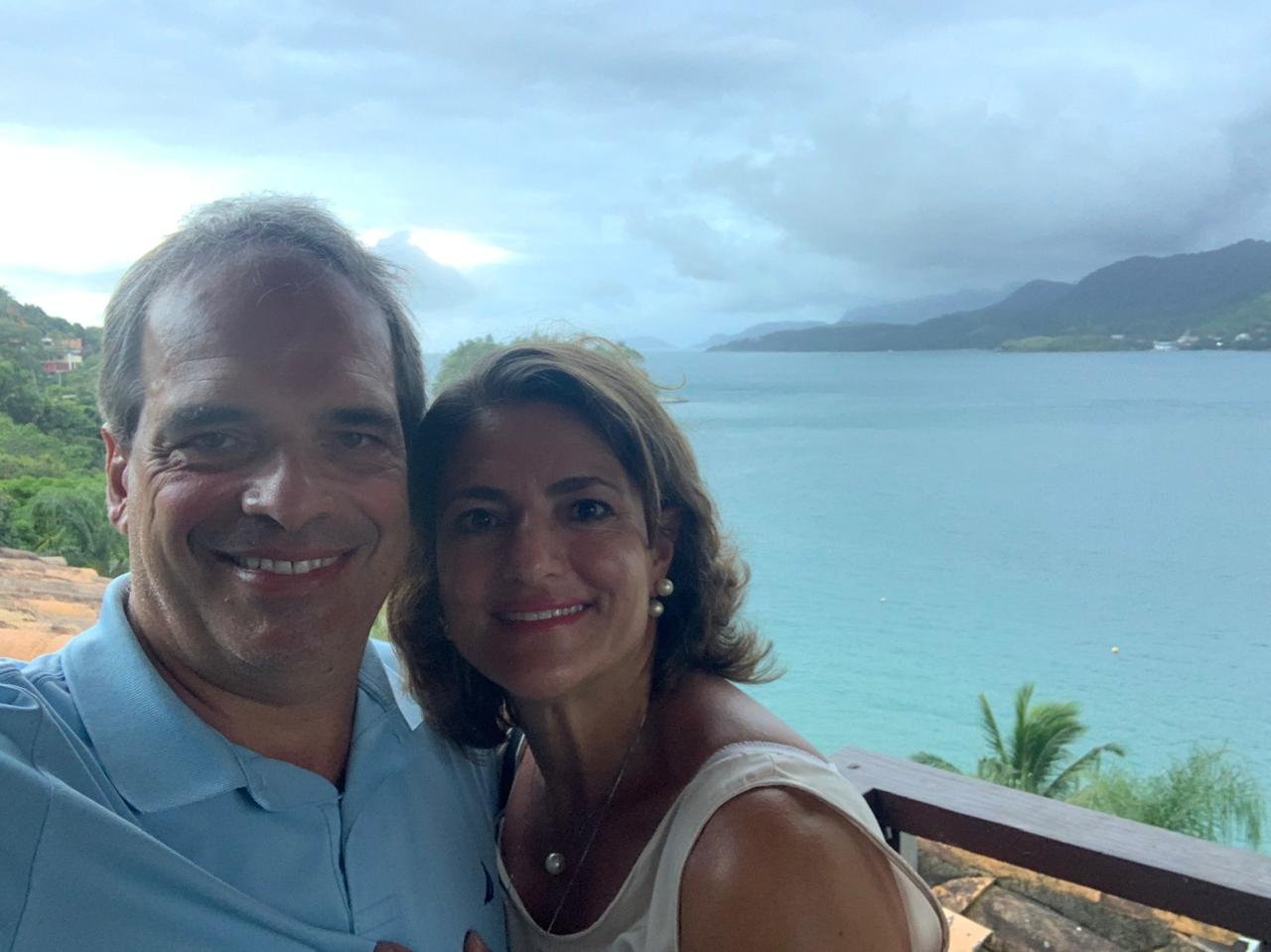
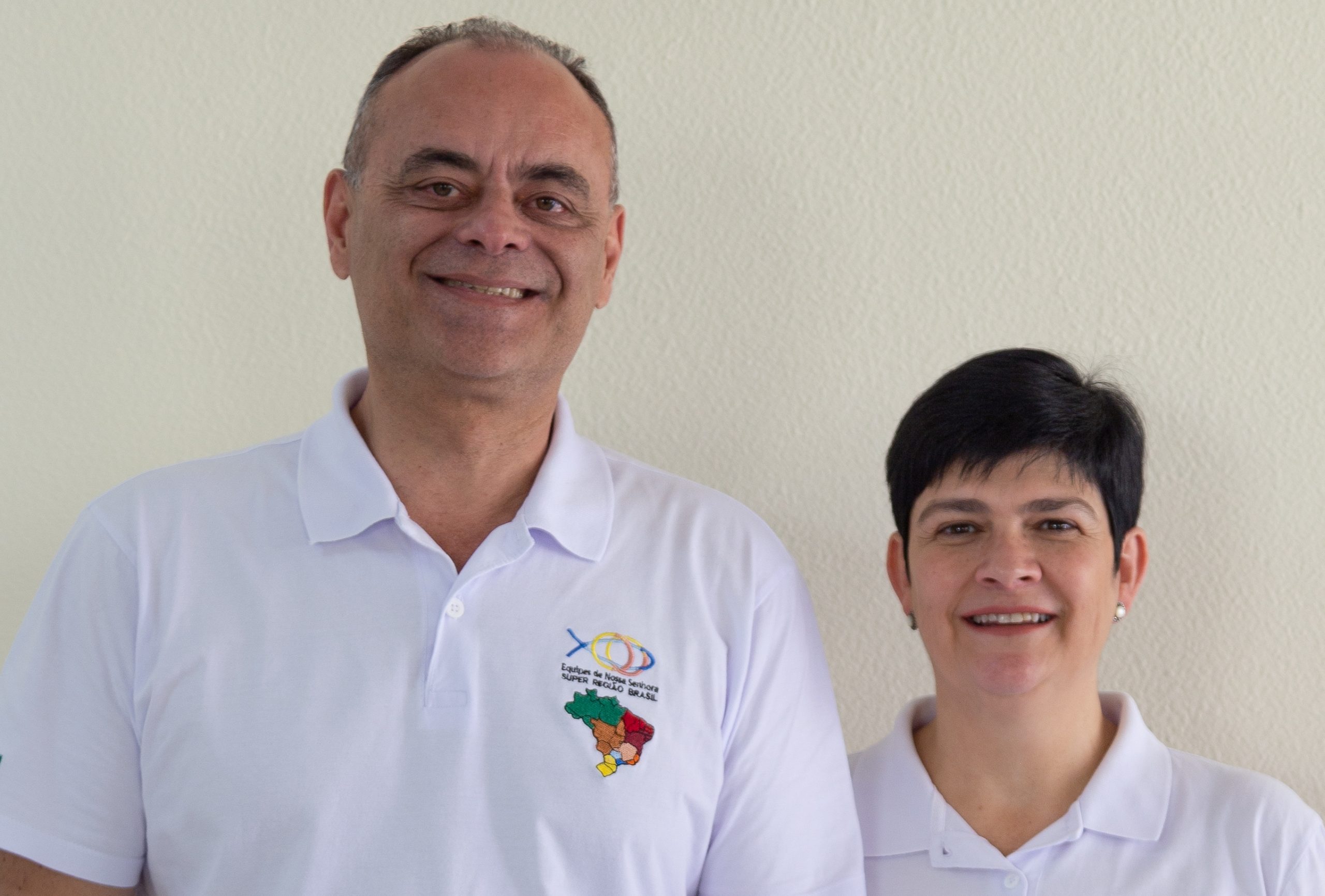
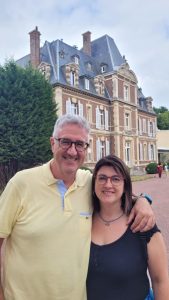
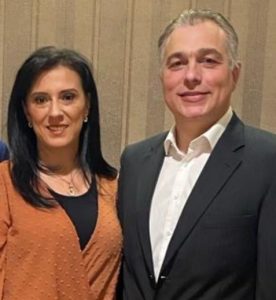
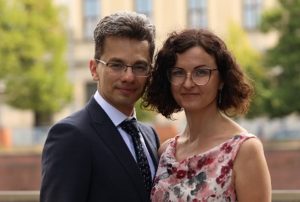
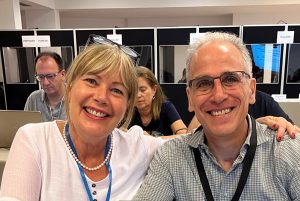
We are Cristiane and Luiz Antonio Brito, born in Brazil, in the state of São Paulo, in the city of São José dos Campos. We have been married for 36 years and have two daughters, two sons-in-law, and two wonderful grandchildren who are a joy in our home..
We began our mission as the liaison couple for the Americas Zone on the International Responsible Team at the Turin Meeting in 2024. From the very start, we asked that you never forget to pray for this entire team, asking for the gift of discernment, strength, and perseverance throughout the duration of our mission.
Cristiane is a businesswoman and runs three cosmetics stores in our city together with our daughters, who are her partners. Brito is an engineer and divides his time between engineering work and teaching undergraduate and graduate courses at a university. We remain professionally very active.
We began our journey in Teams of Our Lady in May 1999. In 2001, we served as the team responsible couple, then as liaison couple, and later as responsible couple for a Sector and a Region, a mission we completed in 2013.
From 2014 to 2018, we were part of the Brazil Super-Region Team, where we were responsible for communications. From 2018 to 2022, we collaborated on the International Intercessors Animation Team and coordinated the Editorial Council of the Brazil Super-Region, which carried out a review of several documents, including the manuals for the liaison couple, team responsible couple, sector, and region.
As we have already shared, we have now taken on our role on the International Responsible Team as the liaison couple for the Americas Zone. Since joining the Movement, we have continually been in mission, and we see each of these calls as a gift from God. We thank Him at every moment for these opportunities.
Alongside our missions within the Movement, we have served in our parish marriage preparation program since 2002 and as ministers of the Holy Eucharist from 2005 to 2022, serving at Mass and bringing the Eucharist to the sick in their homes and in hospitals.
We would like to share in this space some of our experience regarding the importance of availability for mission in Teams of Our Lady. Mission is a reality for everyone in the Movement. If the call has not yet arrived, do not worry — it will, because every responsibility in the Movement has a beginning and an end.
There is a rotation among the couples who serve in these roles, so that everyone, at some point, will be called.
At the start of these various calls, our main question was: why were we receiving this mission and not other couples whom we considered — and still consider — to be better prepared and more capable than us? In the first calls to the missions we have already described, like good team members, we sought out our team’s spiritual advisor priest, who calmed our hearts a little. He offered us a reflection based on the passage from John 15:16: “You did not choose me, but I chose you,” and he challenged us: “Instead of asking why you, ask why not you.” This reflection touched us deeply: “Why not us?” What would keep us from accepting this service? Then our humanity kicked in, and we made a long list of reasons not to accept the call. But after a little reflection and, above all, prayer and the Eucharist, our excuses fell away one by one. There was nothing that prevented us from taking on the responsibilities to which we were being called. We learned during this time that if a problem is too large for you to solve, if it exceeds your abilities, it stops being yours and becomes the responsibility of the one who is capable of solving it — and as it is written in Matthew 19:26: “With man this is impossible, but with God all things are possible.” Since then, we have handed our mission and our obstacles over to God. In prayer we say: “We accept the mission to which You have called us in Your Church, but please help us with what we cannot resolve.” As we said at the very beginning, we are still professionally active, and we always entrust our professional commitments to God; He takes care of our schedule. God is merciful; God abandons no one. He promised us this in Matthew 28:20: “And surely I am with you always, to the very end of the age.”
Another reflection came to us from an editorial in the Monthly Letter written in 1964 by Father Henri Caffarel: “More modestly, I want to invite each person to ask themselves: Why did I join the teams? To receive or to give?” This passage helped us with the question of “why not me?” that we had already raised. But as we went deeper, it raised another question for us: our responsibility when we take on something in the Movement — toward those who are here now, and toward those who came before us, whether or not they are still part of our lives. Today, when we think about it carefully, being a team member is relatively comfortable: it simply requires our dedication and effort. Our Movement has various levels of responsibility, a very clearly defined rule for handing on service, its own methodology for monthly meetings, formative documents that prepare us for our journey toward holiness, annual study themes, encouragement to deepen our specific points of effort, and many formation opportunities within the Church and the Movement. But what about those who came before us? Can you imagine how hard it was to build all of this? Have you considered what it meant to deal with a new way of seeing marriage within the Church — conjugal spirituality? Have you thought about how many gave up, but above all, about how many persevered? And it is precisely out of respect for those who persevered that we too must think about giving our part to the Movement, not just receiving. If it were not for the great dedication of many pioneers, the Teams of Our Lady would simply not exist today; and it is also through our dedication that others will be part of the Movement in the future. Or does someone think about letting the Movement end or grow weak in their country because they are unwilling to serve, unwilling to take on a mission as a Pilot Couple, Sector or Region Responsible Couple, or any of the other many opportunities the Movement offers us?
Mission also involves prayer and discerning what God wants from us. Accepting a mission does not mean stopping being a team member; it does not release us from retreats, prayer, meditation, reading the Word, and especially the Eucharist — on the contrary, it commits us even more deeply.
The specific points of effort are a powerful tool we have received from our Movement to discern God’s will. Let us remember that it was not we who chose the mission we have taken on, but that God chose us for this mission; that God enables our participation in this mission, that God supports us in our fears and insecurities — and He does all of this so that His will may be done, not ours. And to know God’s will, only through prayer, meditation, and the Eucharist will we be able to surrender to the action of the Holy Spirit so that the mission may bear fruit.
We can also recall another word from Father Henri Caffarel, who was already inspiring Teams of Our Lady in 1959 with his characteristic radicalism: “With even more conviction than on the day when I was writing this for the first time, I believe that Teams of Our Lady should not be a refuge for adults, but rather guerrilla corps made up exclusively of volunteers, whose members earnestly seek to deepen their Christianity in order to live it without compromising it in the family, in the workplace, and in the world.” Two words we ask you to reflect on, in a mature way, perhaps while taking a moment to sit down: refuge for adults and volunteers. Think about these two options: which one is more pleasing to God? And at the close of this reflection we are sharing with you, we leave you with a conviction we have built during this time in mission: “The yes may be hard, but the no is impossible.”
A big embrace to all of you — count on our prayers. Stay with God.
Cristiane and Brito, Liaison Couple for the Americas Zone, International Responsible Team
The Spiritual Counsellors and Advisors of the Teams in the teachings of the Popes – II
In the December 2025 letter, I suggested that we begin reading the words of recent Popes addressed to the Spiritual Counsellors in their messages to the Teams of Our Lady.
In this letter, we continue with Pope Paul VI, reading his message addressed to the Teams of Our Lady on September 22, 1976, during the audience with the participants in the Fifth International Gathering held in Rome. Let us recall the theme of this meeting: “The Teams of Our Lady in the service of Evangelization.”
Immediately after emphasizing the importance of the Movement’s charism and encouraging it to “continue to be” faithful to its vocation as “schools of conjugal spirituality” faithful to the Magisterium of the Church, the Holy Father Paul VI addressed the Spiritual Counsellors:
To the priests who are chaplains of the Teams, “I exhort them, as a priest like them, a witness to the sufferings of Christ and as one who must share in the glory that is about to be revealed” (1 Pet 5:1). Do not hesitate to give the best of your skills, your strength and your pastoral zeal to this privileged apostolic field. You will find there a portion of the Church of which you are pastors. Do not give in to the temptation to believe that your pastoral work is limited to a small group of Christians. Your work will be multiplied by the influence of so many couples. You help them to deepen their Christian life; may yours deepen in equal measure.
- “To the priests who are chaplains of the Teams, “I exhort them, as a priest like them, a witness to the sufferings of Christ and as one who must share in the glory that is about to be revealed” (1 Pet 5:1).”
This biblical text could be considered simply a kind gesture from the Holy Father. But it is also possible to see in it a message he wishes to convey to the Spiritual Counsellors.
Let us see what Peter says to the elders. At the end of this letter, including himself among the elders, Peter exhorts them to shepherd the local churches as good shepherds. He reminds them that their pastoral authority to guide, instruct, and protect the flock in their care derives from the supreme authority of Christ, “the chief shepherd” (5:4). Furthermore, as those responsible for the welfare of the Lord’s flock, he warns the elders not to abuse their authority with malice, greed, or oppression (5:2-3). They must exercise this service “willingly” and not as a burdensome duty. Likewise, they should not be motivated by “greed,” but by a desire to serve the community (5:2b).
Finally, and most fundamentally, elders should not “rule over” those entrusted to them but rather serve as models or examples for the community. Through the way elders exercise their leadership, they can bear witness to Christ’s redemptive sufferings (5:1). The reward offered to them is the same vision that draws the whole community toward the future: “the unfading crown of glory” (5:4). This sharing in glory will take place “when the chief shepherd appears” (5:4).
- “Do not hesitate to give the best of your skills, your strength and your pastoral zeal to this privileged apostolic field. You will find there a portion of the Church of which you are pastors.”
The Holy Father recognizes the Teams of Our Lady movement as a “privileged apostolic field,” undoubtedly considering married life and families, and further confirms it as “a portion of the Church,” with the clear intention of assuring the Spiritual Counsellors that in their service to the TOOL they are also serving the Church as pastors, just as they do in their parish and diocesan pastoral ministry following the example of Christ, the Good Shepherd. Let us recall Peter’s recommendations to the elders.
This recognition is very important, above all, if we bear in mind that even for some priests and bishops, the supra-diocesan and non-parochial nature of the Movement makes it difficult for them to understand it, welcome it, and, even more so, accept the invitation to be Spiritual Counsellors when the couples do not belong to their parish or ecclesiastical jurisdiction.
Pope Paul VI urges counselors to “do not hesitate” to offer the best of their intellectual, human, and pastoral abilities in serving married couples as pastors of the Church. Therefore, the Spiritual Counsellor’s service cannot be seen, either by couples or by priests, as something isolated or merely extra work for their pastoral ministry in the Church.
- “Do not give in to the temptation to believe that your pastoral work is limited to a small group of Christians. Your work will be multiplied by the influence of so many couples.”
The Holy Father wisely warns against the doubt that assails so many Spiritual Counsellors who are also pastors of small or large parishes, thinking that they are wasting their time with a group of five or seven couples from the teams. Faced with this temptation, the Holy Father reminds them that married couples in the movement, in their missionary duty, will radiate among many other couples and families the spiritual goods learned and lived in the movement. The Church recognizes that, by the grace of the sacrament, Christian married couples are the principal agents of family ministry.
This has been my experience as a Spiritual Counsellor and a parish priest. The couples in the teams are now responsible for the marriage preparation course, pre-baptismal catechesis, annual retreats for parish couples, etc. I invite them because, in the teams and with the accompaniment of the spiritual counsellor, they receive a solid doctrinal and spiritual formation that not only enables them to teach, but also encourages them to be witnesses of conjugal and family love, not with theories, but by showing from experience the attractiveness of love lived in the sacrament of marriage. In this sense, conjugal spirituality and mission enrich each other.
- “You help them to deepen their Christian life; may yours deepen in equal measure.”
This last recommendation from the Holy Father suggests that I propose for your reflection a text from the Guide on “The Priest Counsellor and the Spiritual Accompaniment in Teams of Our Lady,” when it refers to the complementarity between couples and Spiritual Counsellors:
The great progress made by Teams of Our Lady throughout the world in the light of Vatican Council II has enabled us to understand that priests and lay people can help each other progress in the knowledge of Christ’s mystery. On the one hand, priests guide couples in their difficult daily discernment, on the other hand the presence of couples who pray and love each other, helps priests to exercise their ministry with more dynamism and deeper fruitfulness (p.17).
Edmonton, March 2026
Father Augusto Garcia PSS